
We invite you to read more about our worship ministry philosophy below. If you have any questions, please feel free to contact our Worship Pastor, Lindsey Miller.
Our Philosophy of Worship
Introduction
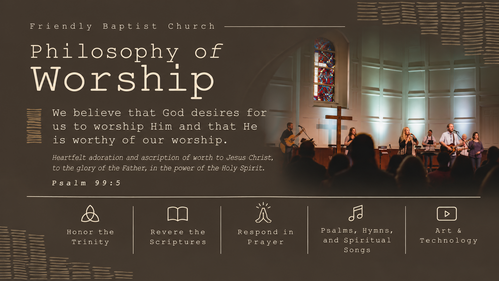
We believe that God desires us to worship Him. God tells us in Isaiah 43:7 that man was created for God’s glory, and in Psalm 99:5 we are called to exalt Him and worship at His feet. We define worship as the heartfelt adoration and ascription of worth to Jesus Christ to the glory of the Father in the power of the Holy Spirit in response to His revelation to us. We further believe that worship is a daily lifestyle of abiding in God through prayer, reading His word, and testifying to His goodness. After a week filled with various struggles and concerns, Friendly Baptist Church gathers every Sunday, the Lord’s Day, with the stated purpose to equip believers to engage the community to advance the kingdom of God. The philosophy of corporate worship at Friendly Baptist Church is Scripture-focused and prayer-minded, consisting of refreshing worship elements that edify believers to the glory of our Triune God.
Honor the Trinity
Jesus Christ is worthy of our worship. The book of Revelation proclaims the worthiness of Jesus to receive worship (Revelation 5:12) as He is worthy to receive honor, glory, and blessing because of His sacrifice as the Lamb of God. The Father, who has bestowed on Jesus the Name above all names, is Himself glorified at the worship of His Son (Philippians 2:9-11). As the church proclaims the truth of Christ Jesus in worship, the Holy Spirit is at work to convict hearts of sin and righteousness and call people unto Him (John 16:8). We recognize and give honor to the Trinity and seek the power of the Holy Spirit to guide our worship of the Son, all to the glory of the Father (2 Corinthians 13:14).
Revere the Scriptures
Worship is a response to the revelation of God, therefore Scripture, the word of God, saturates our worship services. In 2 Timothy, Paul tells believers that the Scripture is profitable for teaching, for reproof, for correction, and for training (2 Timothy 3:16-17). We apply this to our worship services and incorporate Scripture in several ways. We may simply read Scripture aloud from the platform. We may engage the congregation in corporate Scripture reading together or as a responsive reading, alternating Scripture and response. Or we may have a time of meditation and prayer where a verse or passage is displayed on the screens above the stage. Scripture is simply that essential to our worship. As believers in the truth of God’s word, we make Bibles available to everyone, placing them in the seatbacks of every pew, because we believe that, as Joseph Crider says in Scripture-Guided Worship, “Songs don’t call people to worship, God does through His word” (89). We believe that the Word of God is a vital part of every worship service.
Respond in Prayer
We are blessed and thankful that our Creator God has given us, His Creation, the privilege of communication with Him through prayer. We believe that prayer should be a prominent element of a worship service as well. In Isaiah 56, God speaks to those who hold fast to His covenant, noting that He calls His house a house of prayer! Jesus referenced this verse when He found merchants more prominent than prayer in the temple when He arrived in Jerusalem (Luke 19:46). Paul speaks of the importance of prayer in 1 Thessalonians 5:17-18 where he says, “Pray without ceasing; give thanks in all circumstances.” We encourage participants to pray anytime during the worship service, and to come forward to kneel and pray as they feel led. Not only do we pray throughout the service, but our weekly order of worship is also pointed toward a focused time of prayer for the congregation just before the preaching of God’s Word. This allows participants the freedom and time to prayerfully respond to the prompting of the Holy Spirit during the corporate worship time. We simply stop singing and talking from the platform in order to provide the time and space during the service for our people to pray. When people are finished praying, we conclude the prayer time with a short transitional moment, and one of our pastors brings a sermon. In The Worship Architect, Constance Cherry speaks of prayer as priority in worship and notes the many ways prayer should be considered as part of the whole service (126).
Psalms, Hymns, Spiritual Songs
Many people believe that singing is the worship service, and the sermon is the main event in church. However, at Friendly Baptist Church, we view the entire service as a time of worship, and we engage in moments that will edify and equip our congregation to give glory to the Lord, learn more about Him, and to fellowship and grow with other believers. Some components of a worship service include calls to worship where our worship pastor proclaims the truth of God’s word and the congregation is able to respond as we sing, pray, and participate in worship. As mentioned, individual extemporaneous prayers may be offered from the platform by the worship team, or a formal prayer may be spoken together. At times, a pastor may lead the church in directed prayers together. We engage in corporate Scripture reading, as well as responsive readings with a pastor. Of course, we sing together, consisting of “psalms, hymns, and spiritual songs” (Colossians 3:16). At Friendly, a time of giving offerings is part of the worship service, as giving is a means of worship, like the woman cited by Jesus who gave (Mark 12:43). We hear testimonies, both from individuals and from ministry teams, so that our church may be blessed by the work of God in the lives of others. We observe and partake in the ordinances of baptism and the Lord’s Supper. Our pastors bring sermons from the Bible. Finally, we may conduct ordinations of deacons or pastoral candidates, or commission people who are embarking on mission trips. As 1 Corinthians 14:26 promises, we build one another up as we engage in these activities together in an orderly fashion.
Unity
When we sing, we use a modern style of worship that includes various styles of music. In Five Perspectives on Christian Worship, Dan Kimball says, “Culture shapes how people learn, communicate, and express themselves. Therefore, since worship is about expressing love and adoration to God… the culture will shape our expressions of worship” (298). We choose to embrace our current styles of music and spoken word to sing and speak praises to our God. Music styles created in this generation are the styles we typically use to worship. We take advantage of modern instrumentation, new technology in music production, and at times supplement our live music with pre-recorded tracks. At the same time, we honor God when we love others enough to consider the songs of the heart of our senior saints as well as the music that inspires our youth. In Music Through the Eyes of Faith, Harold Best writes, “We should cherish diversity, because God does” (65). In the simple act of deference to one another over musical choices, we foster unity in a very diverse congregation, both in age and background. Jesus prayed for the unity of His followers in John 20:17-26. He sought in prayer for the Father to grant us the unity found in the relationship between He and Father God since before the foundations of the world. In light of these principles, we incorporate a range of styles, a range of tempos, and a range of emotion in the songs we use to honor Jesus. We sing songs of celebration and joy, as well as songs of introspection and sorrow. We follow the theme of the sermon to serve the moment. In Worship Matters, Bob Kauflin notes that when we sing, “we are teaching and admonishing one another (Colossians 3:16) …we’re affirming truth together” (178). The very act of singing together brings together the diverse groups of our congregation in a unifying message of truth.
Orderly
We encourage our congregation to express their worship in prayer, song, and physical expressions of worship, like raising hands in the air, or bowing at the steps of the stage in humility during prayer, as long as their choices are not disruptive to order. Physical expressions of worship are biblical responses that we encourage: clapping with the music as in Psalm 47:1, lifting hands as in Psalm 63:4, bowing and kneeling as in Psalm 95:6, or standing to worship, lifting up the eyes from Psalm 121, and praying aloud or silently. We caution those who are comfortable with physical expression of worship to be mindful of their effect on others around them, and to exercise grace toward others to minimize distraction to other worshipers. Discernment about appropriate levels of physical expressions is wise. Our youth worship teams may lead youth to dance and shout in their worship time on Wednesday evenings, as David did in 2 Samuel 6. Our adults are more often less inclined to be as active, so in that larger congregation, this same spiritual activity would likely be disruptive.
Art & Technology
We take advantage of and use technology to enhance the effectiveness and aesthetic beauty of the space during our worship time. Isaiah 60:13 shows the importance of beauty in the sanctuary of the Lord as He uses various styles of wood, “to beautify the place of My sanctuary, and I will make the place of My feet glorious.” We have many elements that are consistent with providing artistic beauty in our sanctuary for corporate worship. Large screens with artistic backgrounds, used to illuminate the words of the songs we sing, are prominent. Subtle, ambient lighting on stage enhances the environment and compliments the artistic backgrounds from the screens. At times, ambient music may be played to match the emotion of the service, particularly before the service as a prelude to worship, during the prayer time, or as a benediction. Video presentations are sometimes shown on the large screens during services to engage the observers’ senses with other artistic elements. These contributions are all stylistic choices made to heighten the beauty and artistic impressions in the worship environment. The Bible speaks of the splendor of the temple in the Old Testament, adorned in gold, woodgrains, and decorated with various artworks, all for the sake of beauty itself. In Art and the Bible, Francis Schaeffer says, “God is interested in beauty… and beauty has a place in the worship of God” (26).
Ordinnces
The two ordinances of the church, baptism, and the Lord’s Supper, are both elements of worship that are included at various times. We encourage all believers to be baptized in water immersion as a sign of obedience and as a symbolic picture of our identity in the death, burial, and resurrection of Jesus. We observe this as a church, recognizing that this step is also symbolic of identifying with our church as believers, identifying as a congregation in cooperation with the Southern Baptist Convention and the Southern Baptists of Texas Convention, and affirming the Baptist Faith and Message 2000. The other ordinance of the church, the Lord’s Supper, is taken quarterly and during the advent season. We observe the Lord’s Supper during our service, prior to the sermon, as an act of worship and adoration for the Lord, as we remember the sacrifice of Jesus that broke His body, the bread, and spilled his blood, the fruit of the vine (Luke 22:19-20). Our deacons and lay leaders serve the elements of communion to the congregation, but we ask that only baptized believers who are in a right standing with the Lord take and participate.
Conclusion
“Worship stays fresh when we vary the ways that we present each of the aspects of Christ-centered worship,” says Bryan Chapell in Christ-Centered Worship (145). We are from the free church tradition and are not held to any rigid liturgy. As a result, our worship may include some or all of the elements mentioned previously, and the order in which they are delivered may vary. However, we do incorporate these elements with a frequency that allows our congregation to adopt, as habit, the acts of worship that we are called to carry out in showing our affection and adoration to the King. “And the way we acquire such habits is through practice and repetition,” says James Smith in You Are What You Love. We simply love with our heart, soul, mind, and strength the Creator, Redeemer, and Lover of our souls.